
Natural Disaster and Mitigation, Research
Mayon has sudden surge in sulfur gas, Phivolcs warns of potential eruption

People enjoy a view of Mayon volcano from Quintinian Hills in Daraga Albay on June 16, 2023. Jonathan Cellona, ABS-CBN News
The Philippine Institute of Volcanology and Seismology issued a volcanic advisory late Monday, August 17, warning of a potential shift to renewed eruptive activity at Mayon Volcano following a sharp spike in sulfur dioxide (SO2) emissions.
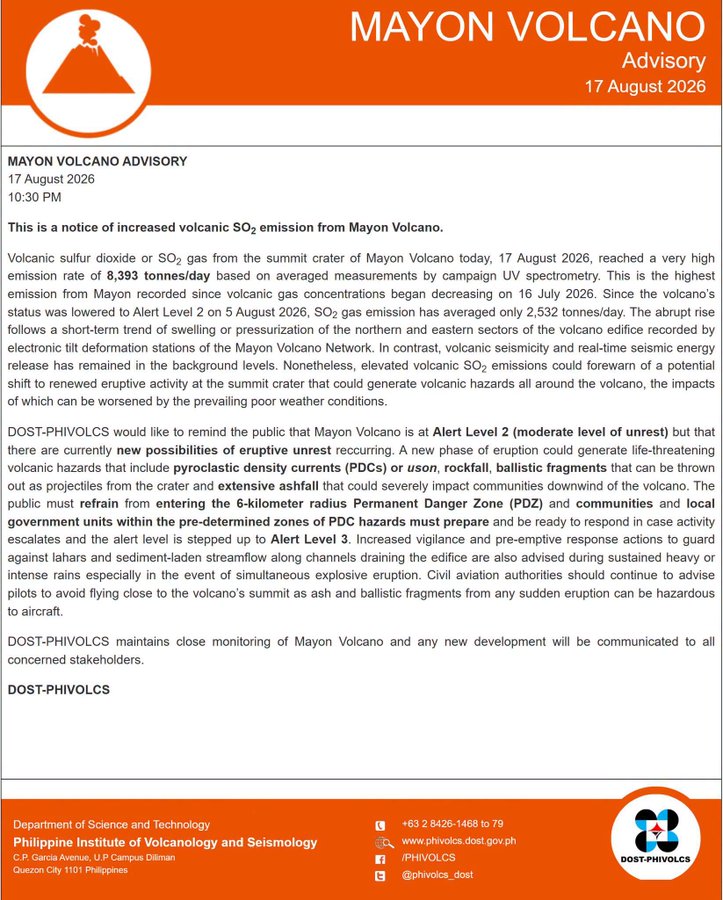
Gas emissions from Mayon’s summit crater reached a very high rate of 8,393 tons per day on Monday—the highest daily measurement recorded since volcanic gas concentrations began decreasing on July 16, 2026.

Since the volcano’s status was downgraded to Alert Level 2 on August 5, 2026, daily SO2 emissions had averaged only 2,532 tons.
According to Phivolcs, the abrupt surge in volcanic gas follows a short-term trend of swelling or pressurization along the northern and eastern sectors of the volcano edifice, as recorded by electronic tilt deformation stations.
While volcanic seismicity and real-time seismic energy release remain at background levels, state volcanologists warned that elevated SO2 emissions could forewarn of renewed eruptive unrest that could be further complicated by prevailing bad weather.
Mayon Volcano remains under Alert Level 2, signifying a moderate level of unrest. However, PHIVOLCS emphasized that a new phase of eruption could generate life-threatening hazards, including Pyroclastic Density Currents (PDCs) or uson, rockfalls and ballistic fragments thrown from the crater and extensive ashfall affecting communities downwind.
"The public must refrain from entering the 6-kilometer radius Permanent Danger Zone (PDZ)," PHIVOLCS reiterated, urging local government units and communities near pre-determined hazard zones to prepare for rapid response should the alert status be raised to Alert Level 3.
LAHAR WARNING AMID HEAVY RAINS
Volcanologists also advised heightened vigilance and preemptive measures against lahars and sediment-laden streamflows along channels draining the volcano, particularly during sustained or heavy rainfall.
Additionally, civil aviation authorities were advised to remind pilots to avoid flying near the summit, as sudden ash explosions and ballistic fragments pose severe hazards to aircraft.
Phivolcs assured the public that it continues to closely monitor Mayon Volcano and will immediately communicate any new developments.
Help this knowledge grow
Have additional information, a correction, or a supporting resource for this article?
Try the form and preview your contribution. Nothing is submitted or saved. Closing the form or leaving this page clears your draft.