
Agriculture
Philippine scientists bat for sweet superfood as next export breakthrough
Philippine scientists are touting a superfood that could be the country’s next major export opportunity, with the means to authenticate it straight from the source.
For decades, global honey producers have touted single-source, monofloral honeys such as New Zealand’s Manuka or North American canola honey as the gold standard of the industry.
Dr. Cleofas Cervancia, a renowned entomologist, ecologist, and long-standing leader of the University of the Philippines Los Baños (UPLB) Bee Program, however, has sung praises for locally produced multifloral honey, noting that homogenous foreign products can't hold a candle to the vibrant, complex profiles found in the Philippines.
"I used to tease my friends and producers in other countries, like Australia, when they would compliment our honey. I’d tell them: ‘Your honey tastes like leather!' Because monofloral honeys are so uniform. If it’s eucalyptus, it tastes like eucalyptus. If it’s canola, it tastes like canola. Apple honey can be astringent. Honey from sunflowers can be very sweet,” Dr. Cervancia joked in an ABS-CBN interview.
The secret to Philippine honey’s multifloral magnificence can be found in Philippine backyards: the natural combination of different nectar sources enhancing Philippine honey’s aroma and overall flavor, making it exceptionally unique.
“We don't have vast monocultures here. Look at a local farm - para siyang chopsuey. You have coffee, mango, coconut, and wild forest trees all in one area. That mix of nectars is precisely what makes our honey taste so good,” she said.
Alexis Dela Cuesta, a CPA and bee farm owner in Davao City, agrees, saying the taste and the texture of honey all depend on the main floral nectar source. This means you can have slightly different flavored honey depending on what flowers are blooming at any particular month.
Want honey with a slight mango flavor? Get honey harvested during the months of November-December. Want honey that tastes slightly like tamarind? Get it in May or June.
“Yung mga bulaklak po natin, mga puno natin, mga halaman, hindi naman sila sabay-sabay bulaklak. So normally po, yung dito sa Metro Manila, November, December, ‘yung mga mangga na hindi naman ini-spray talaga. So ‘yun ‘yung flavor profile niya, mangga. Tapos mahogany, January, February, ganyan. Mahogany naman parang butterscotch ‘yung lasa niya. And then February-March, acacia. March-April is Narra, then May and June yung sampaloc,” he said in a separate interview.
Customers who have tried Dela Cuesta’s honey harvested in San Andres Bukid have also noted the difference in taste compared to honey from his bee farm in Davao City.
“Medyo bundok na siya [sa Davao]. Iba’t ibang puno talaga. May mga durian, African tulips. Minsan di ko na alam kung anong mga puno pinanggalingan [ng nectar],” he said.
THE NEXT SUPERFOOD
The Philippines’ bee landscape features a mix of wild, introduced, and native species, each playing a critical role in local ecosystems and agriculture.
Dr. Cervancia, affectionately referred to as the "queen bee" of the UPLB Bee Program, said there are several types of bees that can be found in the country.
The first type are wild giant honeybees or “pukyutan” (apis dorsata or apis breviligula), a non-domesticated species that produce the vast majority of local honey sold in markets.
The second type are wild dwarf bees (apis andreniformis and apis florea), small wild species essential for forest biodiversity and plant pollination.
European honeybees (apis mellifera) are highly productive managed species used widely for commercial honey yields and targeted crop pollination; Apis cerana are local managed honeybees adapted to the tropical climate while Tetragonula biroi is a common stingless bee species found in the Philippines that yield high-value sour honey, premium propolis, and exceptional pollination for crops like mango.
Dr. Cervancia believes that beyond traditional honeybees, the Philippines holds a major export opportunity in stingless bee honey.
While stingless bees produce far smaller quantities of honey compared to Apis mellifera or wild Pukyutan, their honey boasts a distinct profile. Because stingless bees naturally convert sucrose into gluconic acid, their honey exhibits a pleasantly tart, tangy flavor profile with exceptionally low sucrose levels.
"If you are watching your sugar intake, stingless bee honey has a sucrose content as low as 0.1% to 0.21%—well below the 5% maximum limit set by global Codex standards," she said.
"It offers a totally unique, tangy flavor profile that makes it our best candidate for premium niche export markets abroad."
A March 2025 study published in Trends in Food Science and Technology showed the “anticataract, anti-inflammatory, antimicrobial, antioxidant, antiproliferative, and neuroprotective bioactivities” of stingless bee honey and can be used as a dietary supplement, functional food, medicinal food, and even pharmaceuticals.
Another study, “Identifying bee species origins of Philippine honey using X-ray fluorescence elemental analysis coupled with machine learning”, authored by Dr. Cervancia and 8 other scientists also cited findings that Tetragonula biroi honey contains high levels of specific flavonoids and phenolic acids, such as isorhamnetin, which exhibit powerful antibiotic activity against drug-resistant pathogens, including Staphylococcus aureus.
HONEY FRAUD AND HOW AI CAN HELP SOLVE IT
One problem faced by stingless bee honey producers is the challenge of honey fraud.
A study done by a research team led by Dr. Angel T. Bautista VII from the Department of Science and Technology–Philippine Nuclear Research Institute (DOST-PNRI) showed that only 4 out of 16 store-bought honey samples from the Philippine market were unadulterated or sugar-free.
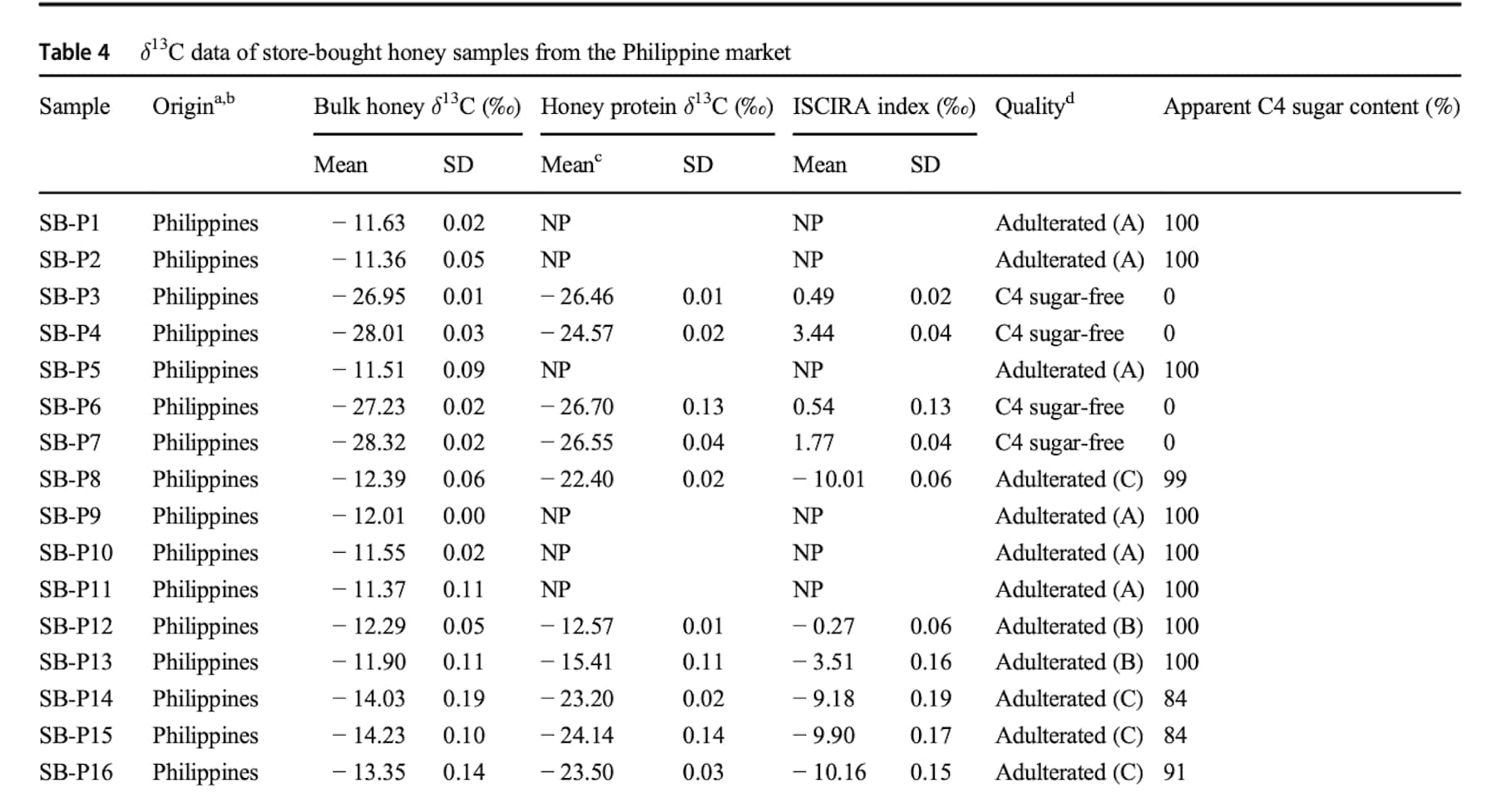
In comparison, 41 honey samples bought from Philippine stores and sourced from Asia, Oceania, North America and Europe were all rated pure, with no sugar additives.
Even more shocking, only 10 out of 74 honey samples bought online and labeled as honey from different party were unadulterated with corn syrup or sugarcane syrup.
Of the 64 online honey samples found to be adulterated, 28 samples showed 80 percent or higher adulteration while 30 samples were 100 percent sugar syrup.
In an interview, Bautista said the team used theInternal Standard Stable Carbon Isotope Ratio Analysis (ISCIRA) for the comprehensive nationwide study, which is considered the gold standard for determining authenticity of honey samples.
ISCIRA works by examining stable carbon isotopes in both the honey matrix and its isolated protein fractions. Because honey naturally derives from plants following the photosynthetic pathway, authentic honey carries a specific isotopic signature.
Any dilution or discrepancy caused by industrial sugar syrups derived from plants such as sugarcane or corn syrup can be detected via ISCIRA.
Bautista said a second phase of the study, which has yet to be released, showed that adulterated honey from online stores in the Philippines has dropped from 82 percent to over 60 percent in the past year.
“What’s said though is that we have found adulteration in some of the foreign honey samples we bought in the market,” he said.
Another challenge in using the ISCIRA method to weed out “honey launderers” is cost: P37,000 for DOST-PNRI to test up to 5 honey samples or an average of P8,000 per sample.
Honey producers who want to show DOST-PNRI certification that their honey is pure can shoulder the cost, except that the certification is only for a specific batch of honey samples.
“Aside from the cost, there is also the issue of time because it takes a minimum of two weeks to finish the test,” Bautista told ABS-CBN.
HANDHELD AUTHENTICATION IN MINUTES
Instead of relying solely on labor-intensive lab techniques, the DOST-PNRI used the data derived from the ISCIRA tests to create an AI model on what to look for in authentic and inauthentic honey.
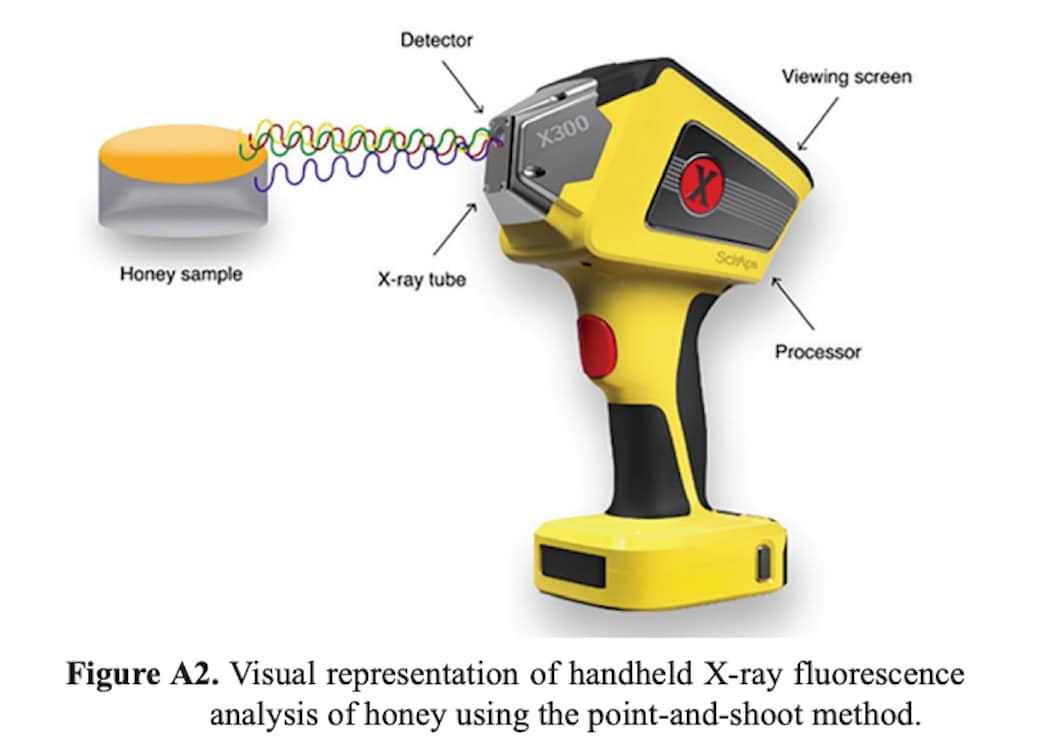
Using a handheld X-ray fluorescence (hXRF) spectrometry device, the team analyzed 25 authentic and 25 adulterated honey samples without destroying it, measuring trace mineral and elemental compositions.
The elemental data was then processed through optimized AI models (Random Forest and Logistic Regression), which showed 94.1% accuracy and 100% specificity in confirming Tetragonula biroi honey.
“The XRF gives you concentrations ng elements inside your sample. Marami yun, sobrang laki ng data. So lahat yun, pinasok namin sa AI model. So parang nag-train kami ng AI model, ito yung malalaking elemental concentrations. So it was successful. Pag sinabi niya na ‘Yes, this is authentic’, we are about 99.5% sure na authentic talaga siya. So basta pumasa sa handheld, pwede mo nang palusutin,” he said.
Since the initial paper, the current AI model has been upgraded and trained using more than 300+ confirmed authentic or fake/adulterated honey samples.
Bautista said the handheld XRF device actually solves the twin problems of cost and time in authenticating honey: one honey sample can be authenticated for as little as P1,500 and the analysis time takes only 5 minutes.
“Ang bilis! So kunwari, if it is adopted by the [Food and Drug Administration] or regulatory agencies, they can bring the handheld XRF right there sa market, pour the honey in the sample cup and then analyze the sample for a minute and a half. Enter the data into the AI model and the model will say if it’s a pass or fail,” he said.
“Ang potential sobrang laki. In the case of stingless bee honey, we’re even moving towards identification of the type of bees that produced the honey. And we have the potential to rival Manuka. We have that potential."
Bautista said handheld XRF devices are not proprietary technology from DOST-PNRI and are widely used by other industries such as mining.
What is proprietary is the AI model, which is now in the last stages of obtaining a patent from the Intellectual Property Office.
One proposal, Bautista said, is to create a spinoff company that will develop the AI model into a smartphone app with a subscription model so that it remains sustainable.
After all, he said, authenticating honey including what type of bees produced the honey and where it came from is just a portion of the bigger use of the AI model.
Bautista said the AI model can also be used to authenticate mango and coffee varieties by identifying its particular point of origin.
“Give us a mango, we can confirm using the same app, using the same technology. The AI model can determine if the mango came from Guimaras or not.”
“We also did it for coffee. Bigyan niyo kami ng coffee and we can confirm it came from Sagada, Ilocos or wherever.”
Bautista said there is huge potential for the AI model that can determine the authenticity of a Philippine product via geographic indication, similar to how European countries prove provenance of wines and cheeses.
He said the AI model can be expanded to authenticate other products such as native fibers used by heirloom weavers, artisanal salt such as “asin tibuok” from Bohol, pomelos and the famous cacao from Davao, and pili nuts from Bicol.
"We're scientists, not businessmen, but the potential for this is huge," he said.
Help this knowledge grow
Have additional information, a correction, or a supporting resource for this article?
Try the form and preview your contribution. Nothing is submitted or saved. Closing the form or leaving this page clears your draft.